
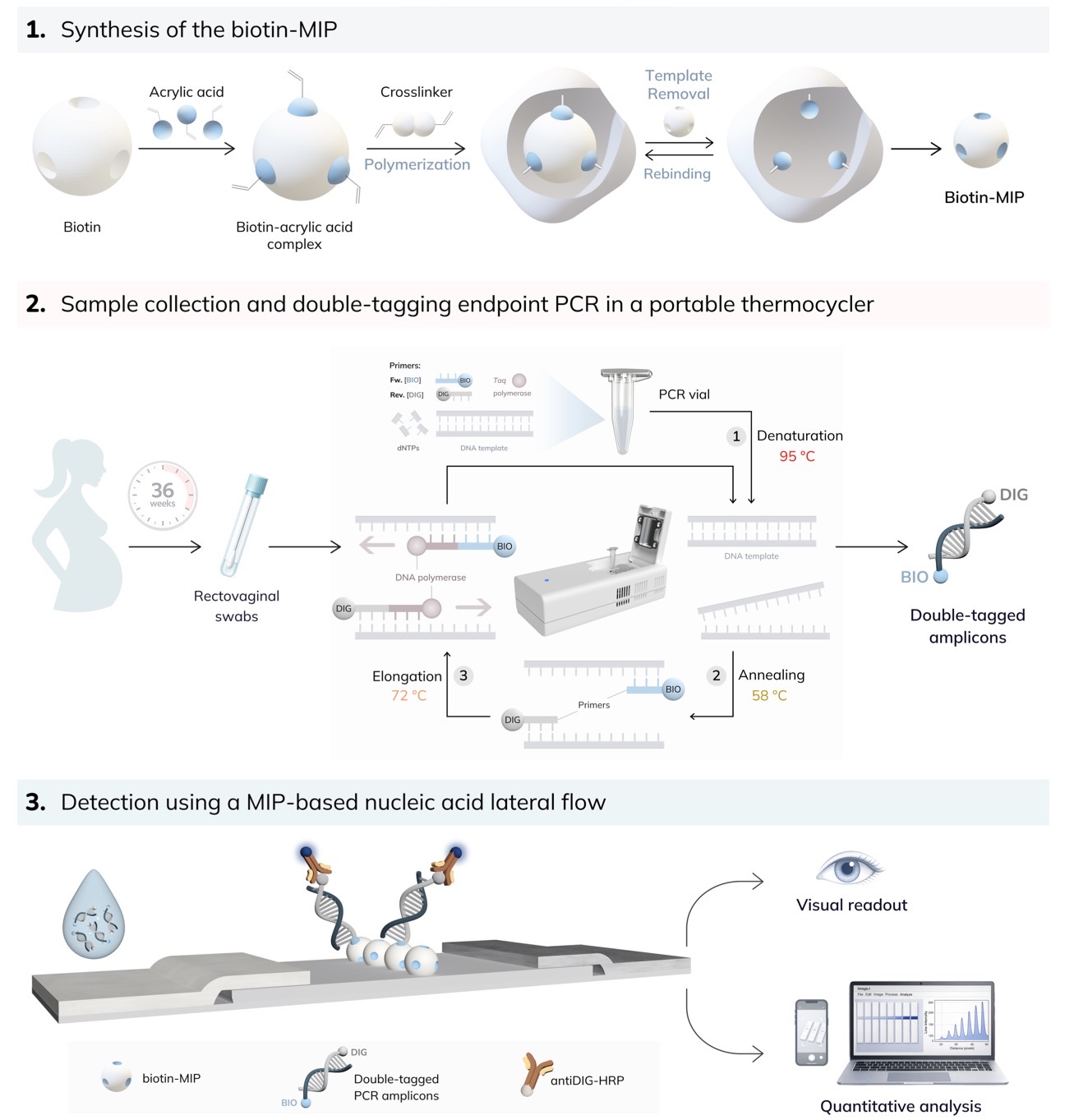
We are happy to share our new open-access publication in Biosensors and Bioelectronics: “Biotin-specific molecularly imprinted polymers as a biomimetic test line in lateral flow assays” (Volume 298, 15 April 2026, Article 118415).
Lateral flow assays are widely used for rapid point-of-care testing, but their reliance on biological receptors can limit long-term stability, scalability, and cost-effectiveness. In this work, biotin-specific molecularly imprinted polymers (biotin-MIPs) are introduced as synthetic recognition elements and integrated directly into the nitrocellulose membrane as the test line for nucleic-acid lateral flow (NALF) assays.
The biotin-MIPs were synthesized, structurally characterized, and first validated using biotinylated horseradish peroxidase as a model analyte. The platform was then applied to the detection of double-tagged PCR amplicons (biotin/digoxigenin) from Escherichia coli, achieving a visual detection limit of 2 ng mL⁻1 and a limit of detection of 1.8 ng mL⁻1, with no detectable signal in negative controls.
Clinical feasibility was assessed retrospectively using swab specimens collected during routine third-trimester screening (35–37 weeks) for Group B Streptococcus, a major cause of neonatal sepsis. In this proof-of-concept study, the MIP-based NALF assay showed complete qualitative agreement with qPCR-based classification and the gold-standard microbiological culture, supporting compatibility with battery-operated portable PCR workflows.
By replacing biological receptors with robust, room-temperature-stable, animal-free synthetic binders, this approach offers a promising and scalable route toward next-generation lateral flow diagnostics for communicable diseases at the point of care.
Reference
Biotin-specific molecularly imprinted polymers as a biomimetic test line in lateral flow assays. Biosensors and Bioelectronics, 298 (2026) 118415. DOI: 10.1016/j.bios.2026.118415
We thank all co-authors and collaborators for their contributions, and the teams involved in sample collection and evaluation for enabling this translational proof-of-concept.