
We are pleased to share our new open-access publication in Biosensors and Bioelectronics: “Electrochemical biosensor for early Alzheimer’s detection and patient risk stratification using plasma exosomes” (Volume 292, 15 January 2026, Article 118061).
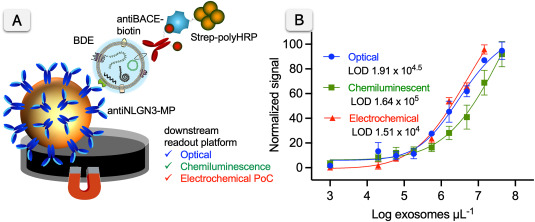
In this work, we developed an immunoassay to isolate plasma brain-derived exosomes using magnetic particles functionalized with an anti-neuroligin-3 (NLGN3) antibody, and then detected the Alzheimer’s-related marker β-secretase (BACE-1) on the captured vesicles. The study evaluates three readout formats (optical, chemiluminescent, and electrochemical) and shows that the portable electrochemical platform provides the best analytical performance, achieving an improved limit of detection (1.51 × 10^4 exosomes µL⁻1) with strong linearity (R² = 0.9829).
The approach was applied to plasma samples from Alzheimer’s disease (AD) patients, individuals with mild cognitive impairment (MCI), and healthy controls, highlighting differences in exosomal BACE-1 levels and supporting the potential of blood-based exosome testing as a non-invasive, cost-effective route for earlier detection and risk stratification.
Reference
Electrochemical biosensor for early Alzheimer’s detection and patient risk stratification using plasma exosomes. Biosensors and Bioelectronics, 292 (2026) 118061. DOI: 10.1016/j.bios.2025.118061
We thank all co-authors and collaborators for their contributions and look forward to building on these results toward more accessible liquid-biopsy solutions for neurodegenerative diseases.